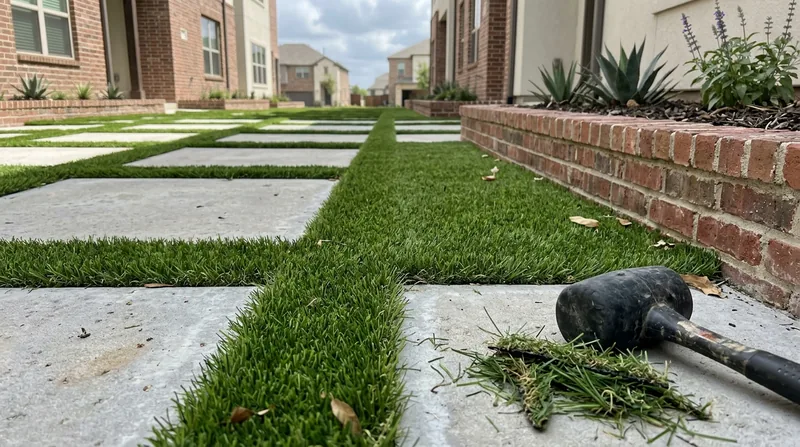




Patio, Balcony & Turf-Paver Strips in Plano transform hard concrete and paver surfaces into usable green space without the maintenance burden of real grass or the heat retention of bare stone. Plano's Blackland Prairie terrain and 100-degree summers create a hostile environment for traditional lawns on patios and balconies, where afternoon sun exposure and poor drainage turn concrete into a liability. Whether you own a brick ranch in east Plano under mature oaks, a two-story in Willow Bend or Deerfield, or a townhome near the Legacy business district, artificial turf on hardscapes solves three problems at once: it eliminates standing water after spring hailstorms, cools the surface compared to bare concrete, and gives you a usable outdoor room year-round. We install turf on balconies, concrete patios, pool decks, and the narrow turf-paver strips that break up monotonous paver courtyards in older east Plano neighborhoods. Every installation includes a drainage mat to shed rainwater, clean cuts along rails and walls, and turf that sits flat and secure so no water pools after a thunderstorm.
Why Artificial Turf on Patios and Balconies Makes Sense in Plano's Climate
Concrete and stone patios in Plano absorb and radiate heat aggressively in summer, making them uncomfortable to walk on barefoot and uninviting for outdoor living. Real grass cannot survive in the deep shade cast by mature oaks and cedar elms that dominate east Plano yards, and even in full sun, St. Augustine and bermuda turf struggle on hard surfaces without proper soil and drainage. Artificial turf solves both problems: it stays cooler than bare concrete, grows in any light condition, and requires no soil amendment or irrigation. The real advantage on balconies and patios is drainage and durability. Plano's spring hail and thunderstorms produce standing water on flat concrete, which breeds mold and mosquitoes. A quality drainage mat under the turf channels water away from the slab and prevents pooling. Turf also protects the concrete underneath from UV damage and thermal stress, extending the life of the patio itself.
- Concrete patios absorb and radiate heat, making them uncomfortable in Plano summers without an insulating layer like turf.
- Real grass fails in shade under live oaks and cedar elms and cannot establish roots on hard surfaces without soil.
- Spring hailstorms and thunderstorms cause standing water on flat concrete, which a drainage mat and turf eliminate.
- Turf protects the patio surface from UV damage and thermal cracking, extending concrete life by years.
- Balcony turf creates a private outdoor room that feels like a garden, not a landing pad.
These benefits combine to make artificial turf the practical choice for any hardscape in Plano where real grass will not grow or bare stone is too hot and slippery.
Key info: Plano's black clay soil drains poorly, and patios built on clay without proper grading often trap water. A drainage mat rated for turf installation channels that water laterally and prevents the concrete from becoming a bathtub after rain. This is especially critical on balconies, where standing water can damage the structure below.
For more on how artificial turf solves drainage and durability challenges, see our guide to turf removal and replacement to understand what happens when improper drainage is not addressed.
How We Install Artificial Turf on Patios, Balconies and Paver Strips in Plano
Installation on hard surfaces is different from installation on soil. The concrete or paver base must be clean, level, and free of debris. We inspect the slab for cracks, low spots where water pools, and any damage that needs repair before turf goes down. A drainage mat is then laid across the entire surface, cut to fit around rails, walls, and corners. The mat is adhered to the concrete with a turf-grade adhesive, and seams are sealed to prevent water from running underneath. The turf itself is then rolled out, stretched to remove wrinkles, and seamed or edge-glued depending on the shape of the space. Cuts along edges are sharp and clean, and perimeter edges are secured with turf adhesive, edging, or fasteners so the turf cannot lift or curl. On paver strips between hardscape, the turf is laid directly on the drainage mat and secured at both edges so it stays flat and flush with the paver surface.
- We inspect the concrete or paver surface for cracks, low spots, and damage that could compromise drainage or turf performance.
- A turf-grade drainage mat is laid and adhered to the entire slab to channel water away and prevent pooling.
- Seams in the mat are sealed so water cannot run underneath the turf and collect against the concrete.
- The turf is unrolled, stretched, and cut to fit the exact dimensions of the patio, balcony, or paver strip without wrinkles or gaps.
- Perimeter edges are secured with adhesive, edging, or fasteners so the turf stays flat and cannot lift in wind or foot traffic.
- Seams between turf pieces are glued or taped to prevent water infiltration and ensure a seamless appearance.
This attention to detail is what separates a turf installation that lasts from one that peels, buckles, or traps water within months.
Local example: A townhome owner in Granite Park near the Legacy district had a 200-square-foot concrete patio that was too hot to use in summer and collected water after every rainstorm. We installed a drainage mat, premium turf with a face weight suited to foot traffic, and sealed all edges. The patio is now cool, dry, and usable from April through October, and the concrete underneath is protected from UV and thermal stress.
For more on how our installation process differs from typical DIY or contractor-grade work, visit our residential artificial grass installation page to see the full scope of our workmanship standards.
Installation Methods: Patios, Balconies and Paver Strips
| Approach | Description | Best for |
|---|---|---|
| Drainage mat on concrete | Turf-grade mat adhered to clean, level concrete with sealed seams and perimeter edges secured with adhesive or edging. | Patios, balconies, and pool decks where water management and durability are critical. |
| Paver-strip installation | Turf laid on drainage mat between paver stones, edges glued to prevent lifting and water infiltration between pavers. | Courtyards and hardscape borders where turf fills gaps and creates visual continuity. |
| Balcony edge detail | Turf cut and secured around railings, walls, and transitions with clean edges and sealed perimeter to prevent water and wind damage. | Multi-story townhomes and apartments where wind exposure and edge security are concerns. |
| Sloped or graded patio | Drainage mat and turf installed to follow existing slope, with drainage channels or swales to direct water away from structures. | Patios with poor drainage or grading that requires water management to prevent pooling. |
Patio, Balcony and Turf-Paver Strips Cost in Plano: What to Expect
The cost of artificial turf installation on patios, balconies, and paver strips starts at $9 per square foot and varies based on several factors. The size of the space, the condition of the concrete or paver surface, the complexity of cuts and seams, and the turf product itself all affect the final price. A small balcony of 100 to 150 square feet with a simple rectangular shape will cost less per square foot than a large patio with multiple seams, railings to cut around, or a damaged concrete surface that requires repair. The drainage mat and adhesive add cost but are essential to prevent water damage and turf failure. Labor, materials, and equipment for a 400-square-foot patio typically run $3,600 to $4,400, while a 1,000-square-foot installation ranges from $9,000 to $12,000. Exact pricing depends on site conditions, which is why we always measure on site and provide a written estimate with the turf product name, face weight, pile height, infill type, base depth, and total cost before work begins.
For a detailed breakdown of costs and factors that affect pricing, visit our full pricing overview. We also offer free estimates within 24 hours at (469) 874-1078, so you can compare our price and approach with other turf installers in the area.
What to Look for When Hiring a Turf Installation Company Near Me in Plano
Not all turf installers in Plano use the same methods or materials. Some crews lay turf on bare concrete without a drainage mat, which leads to water pooling, mold, and turf failure within a year. Others use low-grade turf that flattens under foot traffic and fades in Plano's intense summer sun. When you hire a turf installation company, you should verify that they are fully insured with general liability and workers' compensation coverage, that they provide a written specification naming the turf product, face weight, pile height, infill type and pounds per square foot, and base depth and compaction method. Ask for references and photos of completed patios and balconies, and check those references by phone or in person. If your patio is in an HOA-governed community like Deerfield or Willow Bend, confirm that the installer understands HOA architectural rules and can help you submit an application if needed (though no installer can guarantee approval). Finally, get at least two or three estimates so you can compare price, product quality, and workmanship standards.
- Verify that the installer is fully insured and can provide a certificate of insurance naming general liability and workers' compensation.
- Request a written specification that names the turf product, face weight, pile height, infill type and pounds per square foot, and base depth.
- Ask for references and photos of finished patios, balconies, and paver strips installed in the past two years.
- Call those references and ask about drainage, durability, seam performance, and whether the turf has held up in Plano's heat and hail.
- If your property is in an HOA community, confirm that the installer understands architectural rules and can help with submittals without promising approval.
- Get estimates from at least two or three turf installers so you can compare price, product, and workmanship side by side.
The cheapest estimate is rarely the best value. A turf installation that fails within a year costs more in the long run than a properly installed system that lasts 8 to 10 years. For help choosing the right installer and understanding what separates quality work from shortcuts, contact us for a free estimate and we can walk you through the process.
Patio, Balcony & Turf-Paver Strips in Plano: Pricing Guide
| Service | Price | Details |
|---|---|---|
| Small patio or balcony (100-200 sq ft) | Starting at $9/sq ft | Includes drainage mat, turf, adhesive, and clean edge detail; simple rectangular shapes cost less than complex cuts |
| Medium patio (300-500 sq ft) | Starting at $9/sq ft | Multiple seams, railings, and transitions increase labor; concrete condition and slope affect final cost |
| Large patio or courtyard (800+ sq ft) | Starting at $9/sq ft | Economies of scale on material, but complex seaming, multiple transitions, and site conditions require on-site estimate |
| Paver-strip installation | Starting at $12/sq ft | Narrow strips between pavers require precision cutting, edge gluing, and careful drainage; labor-intensive relative to area |
| Damaged concrete repair and turf | On estimate | Cracks, low spots, or poor drainage require base repair before turf; cost depends on extent of concrete work needed |
| Free estimate and consultation | Included | Response within 24 hours; site visit includes measurement, product selection guidance, and written price with no obligation |
Indicative pricing, the exact cost depends on square footage, finish, and site access. Free personalized estimate within 24h at (469) 874-1078.


